Three volumes. One operating system.
Vol I lays out the architecture. Vol II is twelve sector blueprints. Vol III is the implementation handbook with the 236-sheet Program Atlas. Read end-to-end or jump straight to what matters to you.
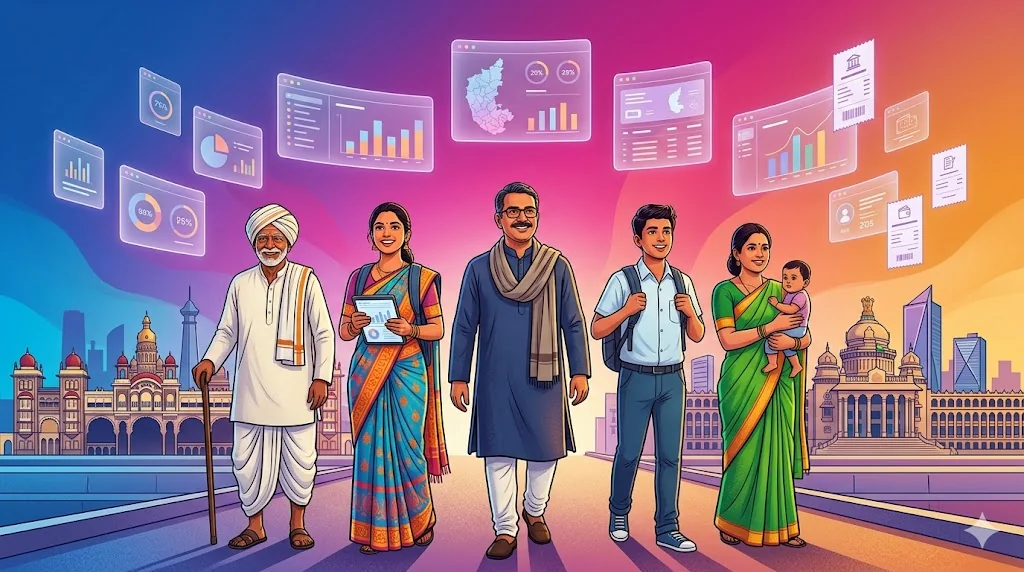
Why government must change. And what the operating system looks like.
Six chapters. Karnataka is not short of laws — it is short of execution. Vol I states the problem, names the five non-negotiable commitments, and details the operating spine that makes them real.
Why Government Must Change
Karnataka is not short of laws — it is short of execution. Chapter 1 names the structural failure modes that any new policy alone will not fix, and introduces the five non-negotiable commitments that recur in every chapter that follows.
- The execution gap Why well-drafted schemes routinely fail at the citizen-facing layer
- The party–government collapse How fusion of party and state captures the civil service
- The honesty trap Why incentives punish careful officers and reward shortcuts
- From schemes to systems Treating the state as an operating platform, not a policy bulletin
The Operating System
The single spine the rest of the manifesto rides on. Six purpose-built data classes, four front doors, the Karnataka State Service Log (KSSL), and the citizen rights that govern all of it. Every sector inherits this architecture rather than reinventing it.
- Four front doors JANATA · Officer Console · Business Portal · Civil Society Interface
- Six publishing surfaces Each with its own sector authority and consent governance
- KSSL coordination spine Mediation · append-only logging · public cryptographic anchoring
- Citizen-rights layer Consent tokens · signed receipts · independent witness co-signing
The 24/7 Governance Engine
The runtime of the operating spine. Mission Control rooms supervise live state operations. Workflow-driven case files replace paper-trail bottlenecks. Payments are tied to verifiable evidence — not promises, not assurances.
- Mission Control rooms Live KPI dashboards · real-time service-level monitoring
- Workflow-driven case files Every state interaction becomes a tracked, timestamped record
- Evidence-based payments Disbursements tied to milestone evidence, not assertions
- Continuous improvement loop Quarterly public retros · KPIs that change as the state matures
Public Finance with 100% Accountability
Every rupee on a public ledger. Every contract searchable. Every milestone payment traceable. Open contracting on the OCDS standard, cryptographically anchored on KSSL, with citizen audit as a normal part of the budgeting cycle — not an after-the-fact exception.
- Outcome budgeting Every line item tied to a measurable, public KPI
- OCDS open contracting Procurement data published in the international standard
- Cryptographic anchoring KSSL roots the financial ledger to public Merkle anchors
- Citizen audit participation Civil-society observers verify against the published data
From Contractor Raj to State Capacity
The state builds the people who run the state. Replace outsourced execution with in-house cadres that own the work, the institutional memory, and the standards. Public works delivered by Karnataka State Works Corps. Critical software shipped by a project delivery cadre. Cryptographic infrastructure run by an engineering cadre.
- Karnataka State Works Corps (KSWC) Public construction with in-house standards
- Project Delivery Cadre (PDC) Permanent state employees who ship software systems
- State Manufacturing Network Public production of citizen-safety goods
- Cryptography engineering cadre Staffs KSSL and the Citizen Security Operations Centre
Ethics, Oversight & Digital Rights
The rules that make the rest of the architecture safe to deploy. Six statutory oversight institutions that survive elections. Four binding tests for every AI or decision system the state ships. A Citizen Consent Ledger that no agency can bypass. Open-source by mandate; threshold cryptography for sensitive actions.
- Six statutory institutions Designed to outlast any government's term
- Four binding tests for AI Every state-deployed model passes them or is not deployed
- Citizen Consent Ledger Personal-data flows require an active, revocable token
- Open-source mandate Civil society can run independent verifier builds
- Threshold cryptography Sensitive actions are split-keyed — no single failure point
Five tiers, one rule: every request enters at the top, every record gets anchored at the bottom.
The spine has three architectural layers plus a security floor plus a cross-cutting oversight rail. Each tier has a specific job. Each tier is open-source. Each tier is auditable by civil society without state permission.
Four front doors
JANATA — citizens. Officer Console — government workflow. Business Portal — firms, suppliers, tax. Civil Society Interface — APIs, bulk data, independent verifier mode.
Five functional services
Identity & Consent · Service Registry · Citizen Case File · Open Ledger & Payments · Grievance Engine. Each subsystem sits inside specific surfaces and institutions — not separate stovepipes.
Six purpose-built data classes
Open Ledger · AI-Use Register · Karnataka Open Data Portal · Citizen Data Trust · Karnataka Digital Twin raw store · Sector operational systems. Each surface is governed by its sector authority.
KSSL — Karnataka State Service Log
Mediation · append-only logging · public cryptographic anchoring. Citizen receipts. Independent witness co-signing. Degraded mode. Citizen Consent Ledger overlay for every personal-data flow.
Built-in, not a programme
Zero-trust + HSM · post-quantum cryptography by default for new builds · SBOM + signed builds · vendor diversity ceiling · threshold crypto for sensitive actions · air-gapped DR · statistical-disclosure standards · offline / low-connectivity baseline.
Statutory oversight that survives elections
Karnataka State Audit Office · Civil-society Independent Audit Board · CSOC (24/7) · Grievance Justice Authority · public verifier nodes · bug bounty · annual red team · annual algorithmic audit · open-source mandate.
Twelve sectors, each with named institutions and six headline KPIs.
Every Vol II chapter follows the same template: problem snapshot · blueprint · how it works · program catalog · finance · KPIs · implementation roadmap · citations. Click through to sectors for the deep dive.
From the architecture into the appendices.
Vol III holds the political framework, the party–government separation, civic literacy, and the 236-sheet Program Atlas (App H) — each sheet a single delivery unit with KPIs, budget, owner, and risk register.
Political framework + closing chapters
Why a new party. Why party–government separation is structural, not rhetorical. Civic literacy. One state, one app. The closing argument.
Reference apparatus
KPI Dictionary · Project Lifecycle SOP · Red Flag Catalog · Open Ledger Data Dictionary · Project Delivery Cadre · Research References. The shared vocabulary every chapter draws on.
Program Atlas · Legal · Cost
The 236-sheet Program Atlas, the legal implementability log, the investment + operational cost workbook. The handbook half of the manifesto, in full.
Ten years. Three phases. Published.
The 10-year horizon is honest about the size of the build. Year 1 lays foundations. Years 2-5 build out the spine across the state. Years 5-10 consolidate, with statutory durability mechanisms that survive electoral cycles.
Foundations · 0-100 days, Year 1
Service charters published for the top 100 services. Open Ledger pilot in 5 departments + 5 districts. Mission Control rooms commissioned. KSSL day-1 architecture live. JANATA Phase 1 covering 25 high-volume services + 25 grievance categories. Project Delivery Cadre design released.
Build-out · Years 2-5
Case-file workflows in every department. Outcome budgeting across all capital works. First state-manufacturing units commissioned. KUHE primary + secondary care live statewide; Catastrophic Care Fund operational by Year 5. KPB launched. 10-12 DHEC campuses operational. 231 taluk anchor centres live.
Consolidation · Years 5-10
A high-trust state — fast services, low leakage, predictable delivery. Citizen Data Trust operational. AI-Use Register binding. Year 10: universal health coverage for all unforeseen serious illness, no means test. All 31 DHEC campuses operational. KAI at full operating scale. Open Ledger reaches every state programme.
Take the manifesto with you.
The full manifesto is available two ways: a single continuous PDF — in full, condensed, or one-page form — or the interactive TPM Reader for paragraph-by-paragraph commenting.
The full manifesto — 600 pages
52 public documents merged in narrative order: Vol 0 Method Note, Vol I architecture, Vol II sectors, Vol III handbook, all appendices. Prefer something shorter? Pick a 12-page condensed edition or a one-page summary when you download.
Download the PDFComment on every paragraph
The interactive reader: every paragraph carries its own comment thread, every comment is read and actioned in the next revision cycle.
Open the TPM ReaderChoose your version
Same manifesto, four versions — pick what suits you.
ಕನ್ನಡ ಸಂಕ್ಷಿಪ್ತ ಆವೃತ್ತಿ5 ಪುಟ · ಐದು ಸ್ತಂಭ, ಸಾಧನಗಳು, ರೀಕಾಲ್, 12 ಕ್ಷೇತ್ರ · Kannada The full manifesto600 pages · all volumes & appendices · ~5.0 MB Condensed edition12 pages · the whole argument, skimmable One-page summary1 page · principle, commitments, the ask