One spine. No rural exceptions.
Rural Karnataka does not need a separate rural government. It needs the same state, with the same SLAs, reaching every panchayat. Reliable infrastructure, Panchayat Service Centres in every village, micro-factories close to home, and stronger Panchayat capacity with open dashboards.
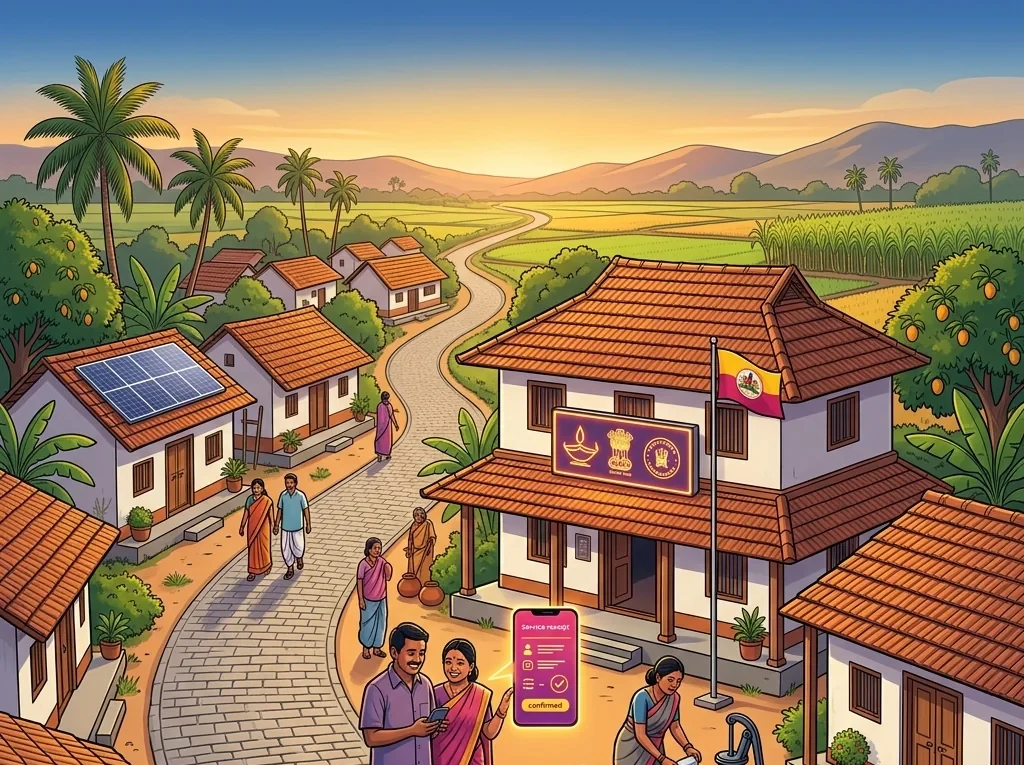
The structural failures in The Rural Renaissance.
Rural Karnataka pays a distance penalty across the basics — distance from services, jobs, markets, infrastructure. When rural areas are under-served, cities become overcrowded by forced migration.
A trip costs a day's wage
Routine certificate or scheme application requires a trip to the taluk centre. The cost of the trip can exceed the cost of the certificate.
Infrastructure unevenness
Rural roads, water, power, last-mile internet — the Maintain step is barely present. Asset is built; nobody owns its upkeep.
Job pathways are distant
Work is often far away, informal, and exploitative. The local economy lacks anchor employers.
Panchayat capacity varies
Gram Panchayats vary widely in administrative, financial, and technical capability. Statute devolves; practice doesn't.
Slow wage payments
MGNREGA wages arrive weeks late. The state spends; the worker waits.
Cities pull people out of villages not because cities are better, but because villages have been allowed to fail. Rural renaissance is the operating decision to bring the spine to the village.
Same spine, no exceptions. Service centres at every tier. Local jobs.
The rural delivery layer runs on the same operating spine as the rest of the state. Panchayat Service Centres are the citizen-facing surface; Works Corps district units are the infrastructure-maintenance surface; State Manufacturing Network micro-factories are the job-creation surface.
Three operating loops.
Three loops that define how the rural delivery layer works when the spine reaches the panchayat.
Walk in, walk out with a case number.
Resident walks into the Gram Panchayat Service Centre.
Trained operator assists with the People's App → application generates a case number.
SLA clock starts; Standard Escalation Ladder fires automatically on delay.
Resident saves a day's wage and gets a published service-level guarantee.
Local work order, fast response.
Local work order raised on the village Asset Registry.
Works Corps district unit responds within the published SLA.
Milestone evidence published on the Open Ledger; payment released on verified completion.
Rapid-repair categories — borewell repair, road potholes, streetlight outages — have shorter SLAs than capital works.
Train, apprentice, place — close to home.
Training in district skill hubs.
Apprenticeship with a local employer or under the Works Corps.
Placement tracking via the Citizen Case File.
Income visible to the resident; taxation + employment data flow clean.
Service centres in 100 days. Full Village Digital Centre coverage by Year 5.
Panchayat Service Centres come first because they remove the day-trip-to-the-taluk-centre cost immediately. Infrastructure refresh runs in parallel.
- Panchayat Service Centre pilot in 5 districts
- Karnataka Panchayat Service Centre Act tabled
- Village Asset Registry pilot in 3 blocks
- First Rural Infrastructure Refresh tranche announced
- Panchayat Service Centres in all blocks of 10 districts
- MGNREGA wage payment median ≤7 days in pilot districts
- Works Corps district units operational statewide
- Village Asset Registry rollout in 10 districts
- Panchayat Service Centres in every Gram Panchayat statewide
- Village Digital Centre coverage ≥50%
- MGNREGA wage payment median ≤3 days statewide
- Rural Infrastructure Refresh — first village-completion tranche
- Village Digital Centre coverage 100%
- Panchayat Service Centre uptime ≥99%
- Rural drinking-water reliability ≥8 hours/day median
- Rural sanitation coverage 100% functional
- Rural-urban distance penalty closed on basic services
- Rural Infrastructure Refresh village completion 100%
- Forced rural-to-urban migration reduced against baseline
- Karnataka exports its rural delivery model under open licence
Six numbers we publish every quarter.
Full set in Vol III App A. Each KPI has a published baseline, Year-1 target, Year-5 target — and where relevant, a Year-10 commitment.
Why The Rural Renaissance can't quietly be reversed.
Rural-urban division has been the easiest political shortcut for decades. Six structural mechanisms prevent the rural rebuild from being quietly defunded.
Rural can't be demoted
Panchayat Service Centres use the same Service Charter as urban. Demoting rural service levels requires statutory amendment, not administrative discretion.
Implementation in practice
Karnataka Panchayat Raj Act devolution implementation audited annually; gaps published; corrective action statutory.
Late payment is detectable
Wage payment records flow through KSSL. Quiet delay or diversion is anchored; the audit trail is public.
Granular transparency
Panchayat-level allocation + spend + work order on Open Ledger. Defects raised, milestones, payments — village by village.
Local job anchor
Micro-factories statutorily anchored to rural blocks. A future government cannot redirect them to metros without statutory amendment.
Annual rural-services audit
Civil-society Independent Audit Board audits rural service delivery annually. Findings public; remedial action triggered.
The spine runs through every sector.
Rural is not a sector — it's a geography. Every sector reaches the village through the same architecture.
Ask the manifesto anything about Rural Renaissance.
The TPM bot answers from the manifesto itself — cited to Volume, Chapter, and Section. Works in Kannada and English.