Karnataka becomes one school.
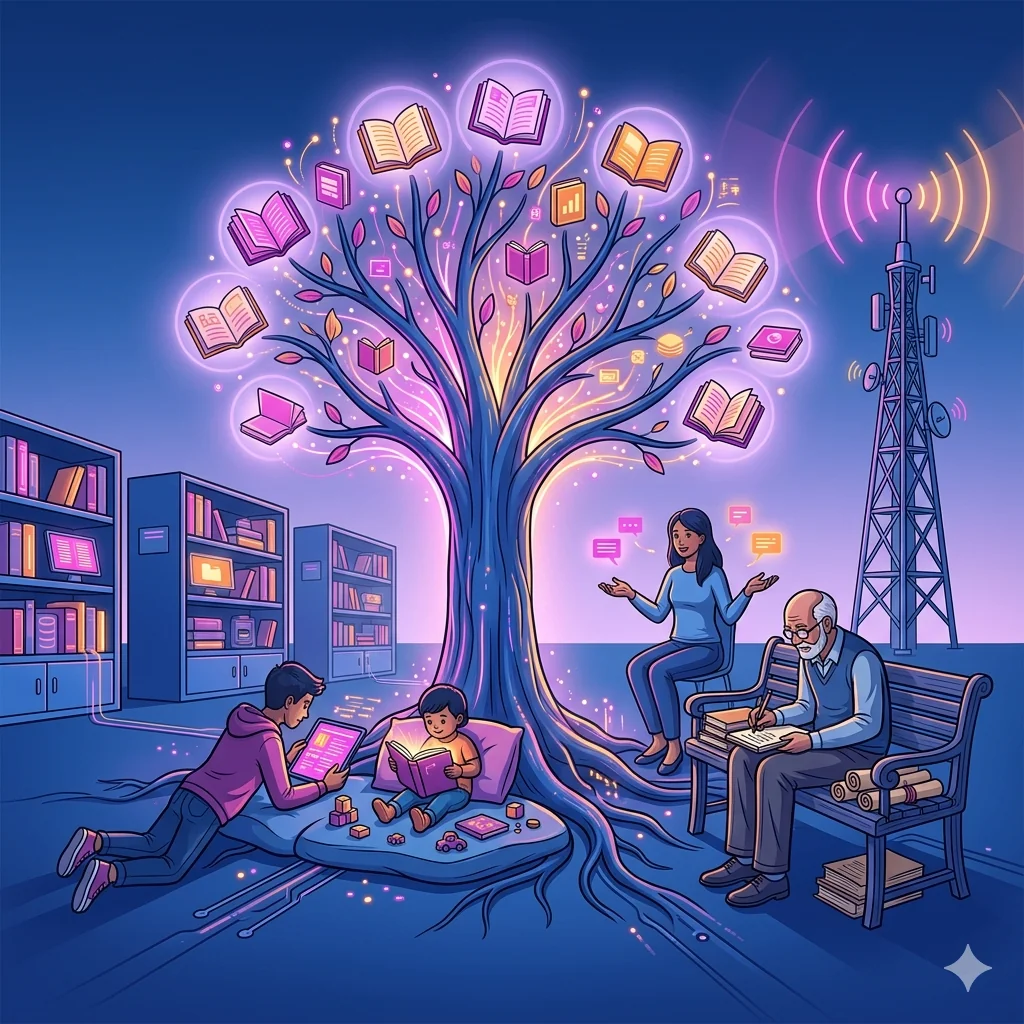
Three guarantees, four institutions, and a Learning State that extends education into every public space — libraries, parks, transit hubs, markets, and broadcast. Education is not a service the state delivers to children. It's a public good every citizen encounters daily, at every age.
Different education for different children, in the same state.
The injustice isn't that Karnataka's children are out of school. It's that the system delivers wildly different education depending on district, language, and family income. Five failures recur, year after year.
Foundational gaps
Many children leave Grade 3 without reading + basic numeracy fluency. Every subsequent year compounds the gap.
Weak teacher support
Teachers overloaded with non-teaching tasks; classroom observation rare; performance signals don't return to the teacher in usable form.
Broken infrastructure
Non-functional toilets. Flickering electricity. Failing drinking water. Unsafe playgrounds.
Transitions break students
Grade 8–10 and Grade 10–PU/college transitions lose the most learners — especially girls, first-generation learners, rural and tribal children.
School-to-skill is missing
Pathways into apprenticeships and skilled employment are scattered; counselling is patchy; family navigates the link to livelihood alone.
The point of public education is not enrolment. It is learning, with dignity, leading to a livelihood.
Three guarantees. Four institutions. One Learning State.
Formal schooling is the spine. The Learning State extends it into libraries, parks, transit nodes, markets, and broadcasting — so education becomes a public good every citizen encounters daily.
Four journeys across the Learning State.
Not programmes you sign up for. This is how learning runs when the system is healthy — for a Grade 1 child, a teenage girl in transition, a parent of a struggling student, and a senior citizen who never finished college.
Daily school day, dignified and ordered.
Morning roster — every student participates equally in cleaning, including toilets. Caste, gender, background irrelevant.
Classroom with a trained, observed, coached teacher. Foundational literacy + numeracy curriculum delivered, in Kannada (or Urdu/Tulu as the child's first language).
Mid-day meal cooked on-premises; safe drinking water; clean toilets that work.
End-of-day learning level updates flow to the Student Case File; parents see their child's progress on JANATA.
Transition tracked, not abandoned.
Dropout-risk signals (attendance, learning level) flag automatically. District Mission Team caseworker assigned.
Counselling on PU options + apprenticeship routes + scholarship eligibility. The state surfaces options; family chooses.
If she chooses an apprenticeship, the pathway lands in a published list with sponsoring employers + skill credentials.
Her case file follows her into higher education or skill training — no "fresh-start" gaps in support.
Information, escalation, trust.
Parent sees real classroom learning level — not a sugar-coated report card. Adaptive coaching plan in JANATA.
Defect at the school (broken toilet, no drinking water) raised on the People's App. School Asset Registry triggers a Works Corps work order.
Parent sees milestone progress on the Open Ledger — every rupee, every contract, every verified completion.
SLA breached? Escalation ladder kicks in: District Mission Team → State Education Authority → Grievance Justice Authority.
The Learning State, always open.
Lifelong-learner role-card on JANATA personalises content + surfaces local events.
District library hosts a weekly civic-sense module on the Continuous Learning Calendar — free, no enrolment.
Karnataka Public Broadcaster runs an editorially independent education stream — radio + TV + podcast in Kannada and English.
District Higher Education Campus offers credit-bearing short courses; the Karnataka Apex Institute is the flagship at the top of the stack.
Statutes in 100 days. Foundational learning measured every quarter.
The Karnataka Education Mission Act anchors the cadre + mission teams. The Karnataka Public Broadcaster Act anchors KPB. Both go up in the first session of the Vidhana Soudha after the result.
- Karnataka Education Mission Act drafted + tabled
- Karnataka Public Broadcaster Act drafted + tabled
- District Education Mission Teams stood up in 5 pilot districts
- Service Charters for top 20 education services published
- Both statutes enacted
- School Asset Registry pilot in 3 districts (defect SLA published)
- Foundational learning baseline survey published
- Daily student-led cleaning roster live in pilot districts
- KPB editorial board constituted; pilot broadcast tracks live
- Foundational learning level ≥70% reading Grade 3 fluency statewide
- School Asset Registry statewide — SLA published per district
- Teacher Professional Cadre rollout complete in pilot districts
- 15 District Higher Education Campuses operational
- ≥90% foundational literacy + numeracy by Grade 3
- 100% schools meet the Karnataka School Standard
- All 31 District Higher Education Campuses operational
- KPB at full daily schedule across Kannada + English + sign language
- Karnataka Apex Institute in steady-state operation
- Continuous learning calendar at every taluk, in every season
- Lifelong-learner role-card adopted by ≥30% of adults
- Karnataka exports its school model to other states under open licence
Six numbers we publish every quarter.
Full set in Vol III App A. Each KPI has a published baseline, Year-1 target, Year-5 target. Aggregated at school + district level — never at the child level.
Education must outlast every government that ever runs Karnataka.
Six statutory durability mechanisms keep the Learning State alive across elections — written into the statutes, not into a manifesto.
Sector budget tied to outcomes, not headcount
The Vol I outcome-budget contract for education ties the next budget cycle to published learning-level gains. A future government cutting outcomes triggers automatic public hearings + Vidhana Soudha review.
Karnataka Public Broadcaster, editorially insulated
KPB editorial board has fixed-term retired-judiciary chair + civil-society members. No party government can replace the board mid-term. Funding is statutorily ring-fenced from the general budget.
Teacher cadre = professional, not political
Single-cadre statute makes teacher transfers + promotions rule-based, not at ministerial discretion. Performance signals return through coaching, not through reward-and-punishment.
Citizen Data Trust rules apply
Data publishes at school and district level only. Never at the child level. The Student Case File belongs to the child + parent; access logged through KSSL; granular consent on JANATA.
School-wise allocation + spend visible
Every school-wise allocation + spend + work order publishes on the Open Ledger. Every defect, every milestone, every payment. Bribery space collapses where transparency runs.
A common curriculum thread across grades
Karnataka civic-sense module runs through every grade and every Learning State layer. Not pledged in the manifesto — codified in the curriculum framework, owned by an arm's-length state board.
The Learning State touches every other sector.
Education isn't a vertical. It's a horizontal that flows through health, livelihoods, civic capacity, and digital dignity.
Ask the manifesto anything about Education.
The TPM bot answers from the manifesto itself — cited to Volume, Chapter, and Section. Works in Kannada and English.