Twelve sectors. One operating spine.
Every sector chapter follows the same template. Every commitment maps to a published programme. Every programme maps to an App H sheet. Pick a sector to dive into.

Learning State Without Barriers
Karnataka becomes a single educational institution — for every citizen, at every age, regardless of gender, caste, language, ability, or location. Formal schooling is the spine; the Learning State extends it into public spaces, broadcasting, and lifelong learning.
Karnataka's education system delivers wildly different futures to children depending on their district, language, and family income. Foundational reading gaps lock in by Grade 3. Teacher vacancies persist for years. The medicine you need is out of stock; the certificate you need takes weeks. The Grade-3 child who cannot read at grade level today will not read at grade level when they leave Grade 10.
Three guarantees
Foundational literacy and numeracy by Grade 3 · Safe, functional schools with published repair SLAs · Clear pathways from school to skills, apprenticeships, higher education, livelihoods · Daily student-led cleaning of every school and college, equal participation across caste, gender, background.
Four institutions
District Education Mission Teams (data, coaching, infrastructure, dropout case-management under one district roof) · Teacher Professional Cadre with classroom-observation-based coaching · School Asset Registry integrated with Karnataka State Works Corps · Student Case File on the operating spine.
The Learning State
Ten programmes that extend learning beyond formal schooling: public-space learning surfaces in 7,000 libraries · Karnataka Public Broadcaster (KPB) with BBC-trust-style independence · continuous learning calendar · Lifelong-learner role-card in JANATA · district + taluk museum network · 31 District Higher Education Campuses (DHEC) · Karnataka Apex Institute (KAI) · mandatory community-service hours · civic-sense module · Sanitation & Lifestyle Educator cadre in larger schools.
- 1. % Grade 3 at FLN level — Year 3 ≥30pp lift in pilot districts; Year 5 ≥50pp statewide
- 2. Teacher vacancy share — Year 3 ≤15%; Year 5 ≤5%
- 3. Per-child Learning State dashboard coverage — Year 3 ≥80%; Year 5 100%
- 4. Dropout rate (Grades 1-10) — Year 3 ≤50% of baseline; Year 5 ≤25%
- 5. Scholarship lag (eligibility to credit) — Year 1 ≤90 days; Year 5 ≤7 days
- 6. Safe-school infrastructure compliance — Year 3 ≥80%; Year 5 100%
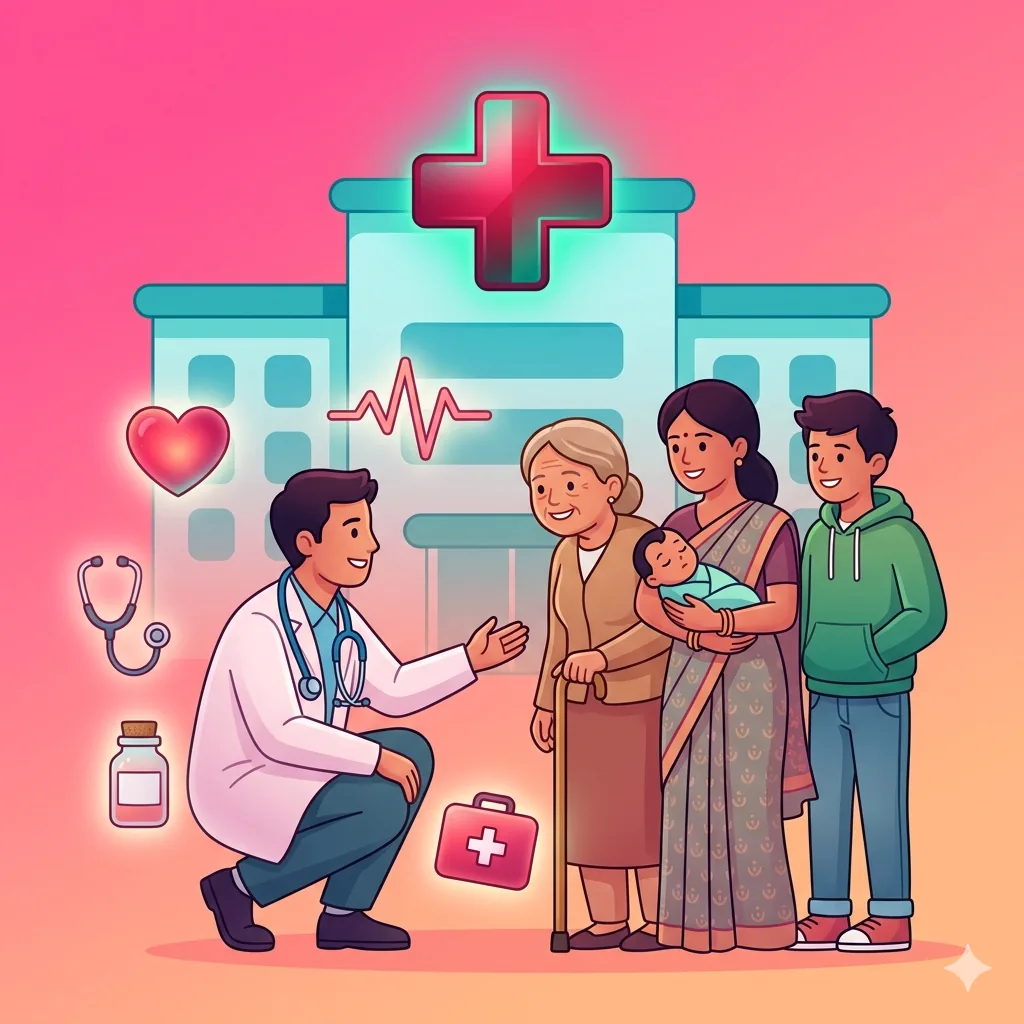
Health as a Human Right
Karnataka rebuilds the health sector as the Karnataka Public Health Delivery Architecture (KPHDA) — six institutional layers as one system, with the Universal Medical Record System (UMRS) as the data spine, and the Karnataka Universal Health Entitlement (KUHE) as the citizen-facing right.
The nearest government hospital ran out of essential medicines last week, and no one was held responsible. Shortages, broken equipment, drug stock-outs, long queues, buildings that leak — these are not policy gaps. They are execution gaps. Out-of-pocket spend on tertiary care still bankrupts families across Karnataka every month.
Six KPHDA layers
Karnataka Health Procurement Authority (KHPA — pooled tendering, OCDS-published, generic-first) · Karnataka Drug & Consumables Distribution Network (KDCDN — three-tier warehousing, real-time stock) · Care Facility Hierarchy (sub-centre → PHC → CHC → district hospital + medical college → 8 regional tertiary hubs → Karnataka Mobile Clinics) · Karnataka Public Health Cadre (Family Health Teams) · Karnataka Health Financing Authority (KHFA) + Catastrophic Care Fund · Karnataka Health Records Authority.
The Year-10 commitment
Primary + secondary care free at point of care from Year 1 under the Karnataka Universal Health Entitlement. Catastrophic Care Fund operational Year 5 for tertiary + rare-disease + high-cost interventions. By Year 10, every Karnataka-domiciled resident has free access to the full diagnostic-and-treatment stack — every district hospital and tertiary hub equipped — for all unforeseen and serious medical conditions, with no means test. Elective + lifestyle care remains paid.
The data spine
Universal Medical Record System (UMRS) — citizen-controlled health record on the operating spine. Consent-based clinical access. AI assists population analytics + decision support, registered on the AI-Use Register with annual algorithmic audit.
- 1. UMRS coverage — Year 3 ≥60%; Year 5 100%
- 2. PHC Family Health Team operational — Year 5 100%
- 3. Mobile Clinic Network — Year 3 ≥400 vehicles; Year 5 ~600 covering every ward/village quarterly
- 4. Universal Health Entitlement — Year 5 full; Year 10 universal, no means test
- 5. KHPA price reduction vs market — Year 2 ≥15%; Year 5 ≥25%
- 6. OOP spend at bottom income quintile — Year 5 reduced ≥80%

Cities 2.0
Four institutions, eight integrated flagship programmes, and one operating rule: published SLAs at ward level, escalation when missed, citizen ratings that trigger audits.
Karnataka cities accumulate years of small civic neglect that no single department owns. Garbage backlogs sit in the same wards for months. Footpath tiles broken in 2019 are still broken. Cables sag across pedestrian routes. Street lights are out. Roads are rebuilt every monsoon and broken every monsoon. The cycle continues because no one is accountable at ward level.
Four institutions
City Asset Registry (every road, drain, footpath, streetlight, lake, water main, sewage line, bus stop, public building catalogued with location, age, condition, maintenance schedule) · Ward-level service SLAs & dashboards · Karnataka Mobility Authority (integrated bus, BRT, metro, commuter rail, last-mile) · Lake & Watershed Authority.
Eight programmes
Day 0-100 Deep Clean (4 cities full-closure 7-10 day windows) · Structural Rebuild (footpaths, drainage, hanging cables, streetlights) · Five Amenities flagship · 100% CCTV with automatic ticketing · AI Traffic Management · Road Safety + free trauma care under Road Safety Programme · Public Sanitation Network · Public Dustbin Network · Karnataka Digital Twin (every ward, full geospatial).
The Karnataka Digital Twin
Photogrammetric 3D model of every Karnataka ward + village road network. Before/after construction videos mandatory for every public-works project, published to KDT. ~5,000 videos/year; civil-society oversight clearance ≥99%. Underpins enforcement on illegal construction, road quality, and footpath continuity.
- 1. Ward-level SLA compliance — Year 3 ≥90%; Year 5 ≥95%
- 2. Road fatalities per 100k — baseline ~9 → Year 5 ≤4.5 (halve)
- 3. KDT ward coverage — Year 1 30-ward Bengaluru pilot; Year 5 100% urban + village road network
- 4. Public CCTV coverage — Year 3 ≥60%; Year 5 100%
- 5. Dustbin segregation compliance — Year 3 ≥60%; Year 5 ≥90% with Environmental Crime Act live
- 6. Maintenance backlog — Year 3 reduced ≥50%; Year 5 reduced ≥90%

Smart Agriculture & Food Sovereignty
A Farmer-First System with one record (the Farmer Case File), four service spines, and one transparency rule.
A farmer's life in Karnataka is a series of risks the state has not insured: unpredictable rain, opaque markets, exploitative middlemen, late insurance claims, and after a bad season — debt. Soil tests are rare. Forecasts are vague. Floor prices are announced but not honoured at the gate. The farmer carries every risk; the state takes the credit when prices are stable.
The Farmer Case File
Every farmer has a case file on the operating spine integrating land record, crop history, services availed, insurance status, market interactions, pending claims. Unit of work for every officer the farmer interacts with.
The KAIA spine — five institutions
Karnataka Forecast & Demand Authority (KFDA — 3/6/12-month district + crop forecasts published on cadence, annual algorithmic audit) · Karnataka Agricultural Extension Cadre (KAEC — field coaches + offline-first advisory platform) · Karnataka State Agricultural Marketing Board (KSAMB — disclosed floor-price offtake) · Karnataka Crop Insurance Fund (KCIF — statutory SLA on claims) · Farmer slot-booking on JANATA for free soil-test mobile units.
Four service spines
Extension 2.0 — advisories arrive before the sowing decision, not after the loss · Water-smart irrigation with maintenance corps · FPOs & market linkages — state as facilitator and intelligent client · Post-harvest storage and processing micro-factories close to the farm.
- 1. KFDA forecast publish-on-cadence — Year 3 100% with annual algorithmic audit
- 2. Farmer slot-booking participation — Year 3 ≥30%; Year 5 ≥60%
- 3. Free soil-test completion rate — Year 3 ≥80%; Year 5 100%
- 4. KCIF claim resolution within SLA — Year 3 ≥90%; Year 5 ≥99%
- 5. KSAMB floor-price offtake reliability — Year 3 100% honoured
- 6. FPO active-membership coverage — Year 3 ≥40%; Year 5 ≥70%

Environmental Resilience & Climate Justice
Karnataka treats climate resilience as a cross-departmental operating discipline. Five operating commitments — district climate risk plans, water security, clean energy + green jobs, pollution control, disaster response — on the same operating spine.
Karnataka's air, water, and forests are deteriorating district by district while monitoring data sits in different siloed systems no citizen can read. Lakes silt up; forests retreat; pollution complaints take months. Climate risk is treated as a research topic, not an operating discipline.
Five operating commitments
District climate risk plans — one per district with hazard mapping, vulnerable-population identification, prioritised actions · Water security as a mission (harvesting, recharge, reuse) under the Lake & Watershed Authority · Clean energy transition with green jobs routed through Karnataka State Works Corps · Pollution control with real-time public monitoring · Disaster response under Mission Control with 24/7 engine.
Karnataka Environmental Crime Act
Open dumping, polluter accountability, hazardous-waste violations under one Act. Activates ward-by-ward post-Deep-Clean; state-wide from end of Year 2. Civic-sense education runs through every layer of the Learning State.
Sensor + data integrity
Air-quality stations at district level. Water-quality streams published to Karnataka Open Data Portal. Forest-loss event detection ≤6h latency. Every sensor reading anchored through KSSL for verifiable integrity.
- 1. Air-quality district-station coverage + uptime — Year 5 100% at ≥95% uptime
- 2. Water-quality stream publication — Year 5 ≥90% of state water bodies
- 3. Environmental Crime Act case-resolution — Year 5 ≥95%
- 4. Public Dustbin Network coverage — Year 3 ≥80% urban; Year 5 100% urban + rural panchayat HQ
- 5. Forest-loss detection latency — Year 5 ≤6 hours
- 6. District climate risk plan publication cadence — Year 5 100% on cadence
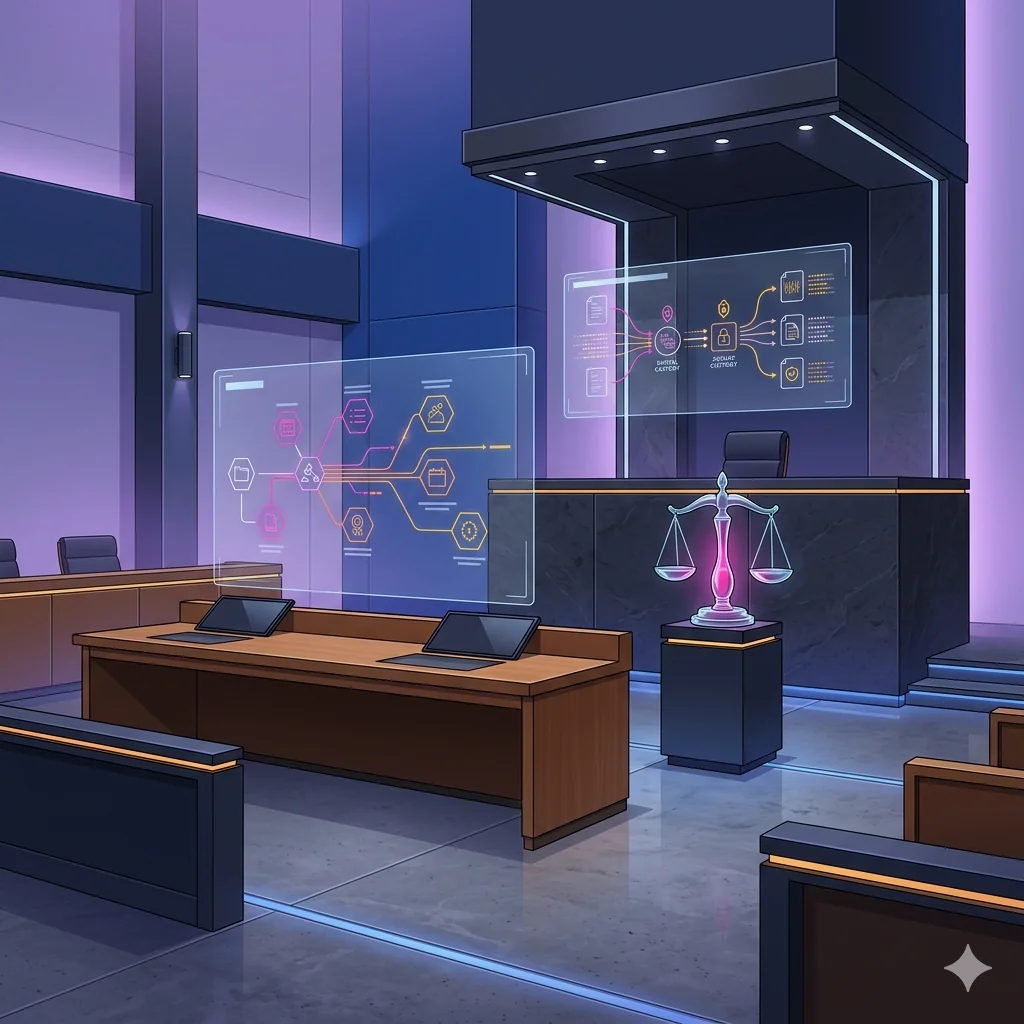
Justice Reimagined
Justice as a case-lifecycle system — published timings, accountable owners, visible outcomes — within the constitutional independence of the judiciary.
Justice in Karnataka has stopped being a service and become a wait. Pendency in courts handling state-defendant cases ranges into years. Forensic capacity is uneven. Legal aid is on paper but not in practice. Police accountability is selective. The result: bribes substitute for due process; the powerful escape; the poor pay twice.
Six operating commitments
Transparent FIR & case tracking on the spine (complainant sees what is happening, when, by whom — judicially permitted privacy) · Forensic + evidence capacity in every district (DNA, digital forensics, document examination) · Strong legal aid + public defender to a published service level · Mediation + fast-track resolution for minor disputes · Police accountability boards with statutory inquiry powers · Asset recovery + proceeds-of-crime processes that resource further capacity.
Electronic evidence + AI custody
Electronic-evidence custody-transfer vault with KSSL anchoring — every transfer cryptographically verifiable. AI-monitored custody framework: every lock-up custody session monitored against statutory framework; compliance audited.
Grievance Justice Authority
Statutory authority with binding adjudicatory power over grievances escalating beyond the spine's own engine. Hears appeals against adverse decisions; can compel disclosure for adjudication. Cross-cuts every sector — the citizen-rights backstop.
- 1. Median pendency (state-defendant cases) — Year 3 ≤50% of baseline; Year 5 ≤25%
- 2. Electronic-evidence custody-transfer integrity — Year 5 ≥99.9%
- 3. GJA median resolution time — Year 3 ≤30 days; Year 5 ≤14 days
- 4. Legal-aid assignment coverage — Year 3 ≥90%; Year 5 100%
- 5. Custody duration within statutory limit — Year 5 100%
- 6. District forensic-lab operational coverage — Year 5 100%
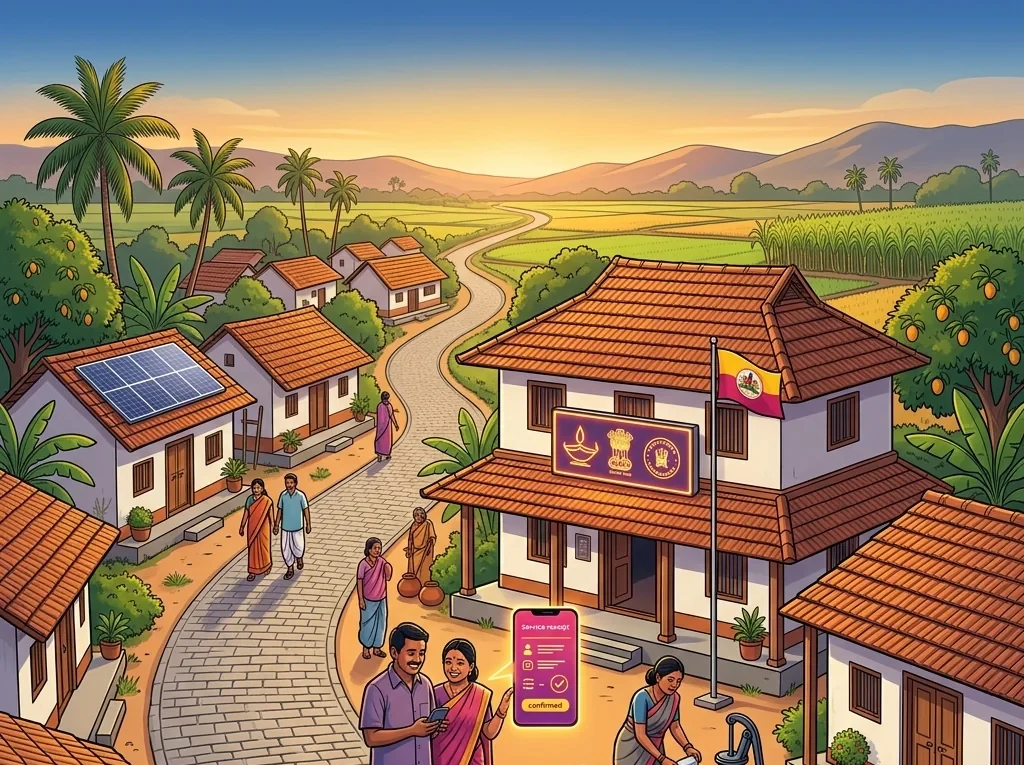
The Rural Renaissance
Karnataka builds a rural delivery layer that runs on the same operating spine as the rest of the state — no separate rural portals, no separate rural exceptions.
Rural Karnataka does not need a separate rural government. It needs the same state, with the same SLAs, reaching every panchayat. Roads break and are not repaired. Drinking water flows for two hours instead of eight. MGNREGA wages arrive weeks late. The result: cities pull people out of villages not because cities are better, but because villages have been allowed to fail.
One spine, no exceptions
The rural delivery layer runs on the same operating spine as the rest of the state. No separate rural portals. No separate rural SLAs. Same service charters, same escalation ladder, same Open Ledger.
Service centres at every tier
Panchayat Service Centres in every Gram Panchayat — assisted access to People's App services with trained operators. Village Digital Centres by Year 5 — last-mile public-internet + assisted access · Rural Infrastructure Refresh — published-window village-level upgrades.
Local jobs
State Manufacturing Network micro-factories in rural blocks · skill hubs at block level · apprenticeships through KAIA + Learning State · stronger Panchayat capacity with open dashboards (Panchayat scorecards, transparent budgets, Karnataka Panchayat Raj Act devolution implemented in practice).
- 1. Village Digital Centre coverage — Year 3 ≥50%; Year 5 100% (per App H H.236)
- 2. Panchayat Service Centre uptime — Year 5 ≥99%
- 3. MGNREGA wage-payment lag — Year 5 ≤3 days
- 4. Rural drinking-water reliability — Year 5 ≥8 hours/day median
- 5. Rural sanitation coverage — Year 5 100% functional
- 6. Rural Infrastructure Refresh village completion — Year 5 ≥50%; Year 10 100%
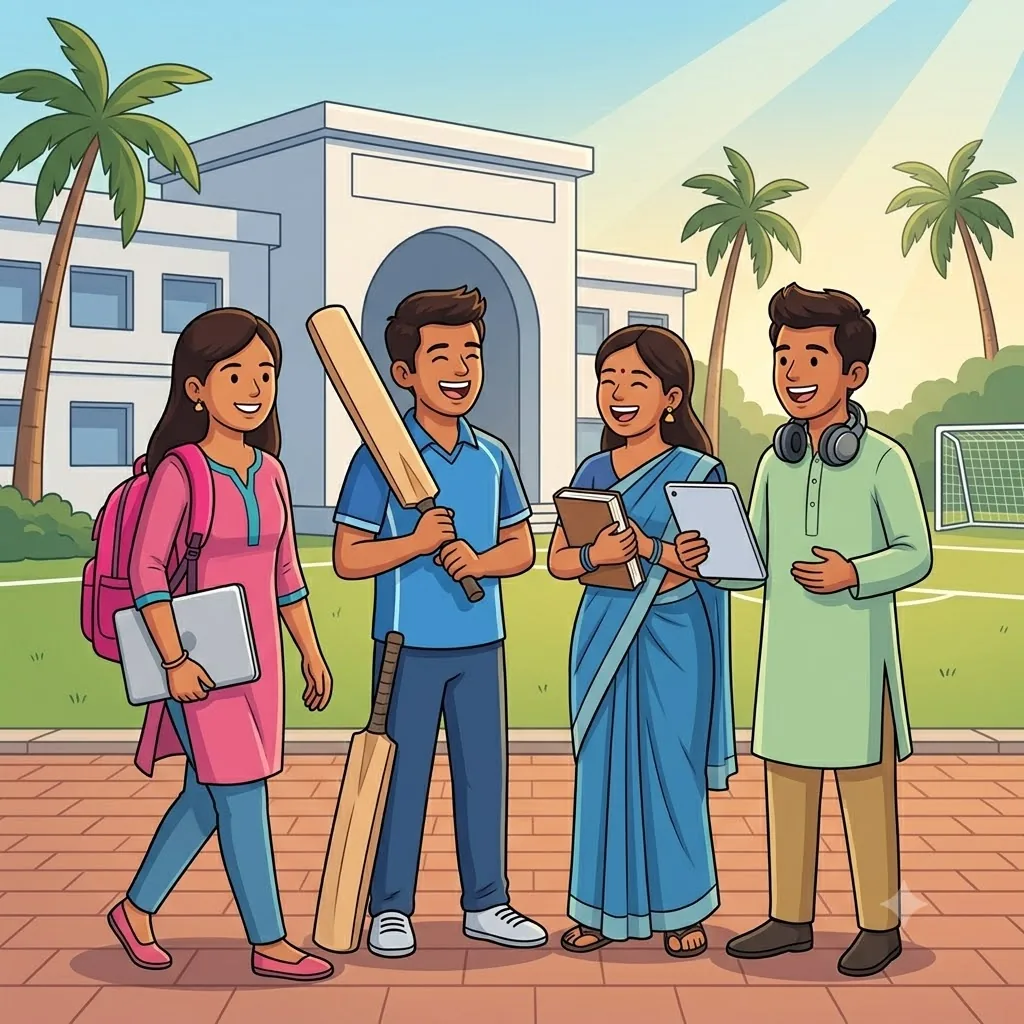
Youth Power & Innovation
Six operating elements — apprenticeships at scale, District Innovation Hubs, procurement sandboxes for startups, open data + APIs, fellowships into government, and Sports & Arts talent identification.
Karnataka has India's most talented young people and the least imaginative ways to keep them. Skill credentials are unrecognised. Apprenticeship pathways are informal. Innovation hubs are press releases. The state procures from the same incumbents year after year. The result: brain drain, civic disengagement, and a youth population whose ambition outpaces the state's ability to absorb it.
Six operating elements
Apprenticeship + internship pathways at scale across MSMEs, large industry, government, civil society, KSWC · District Innovation Hubs (physical co-working + shared workshop, connected to state procurement) · Government procurement sandboxes for startups (limited-scale, milestone-paid pilots) · Open data + APIs under Citizen Data Trust governance · Government fellowships into Project Delivery Cadre + Mission Control · Sports & Arts talent identification at scale.
Youth Civic Network
Active membership channel for 18-30, connected to participatory budgeting, ward-level oversight, the Learning State curriculum. Civic capability not as charity work but as civic-skill credential.
Talent pipelines
Karnataka Apex Institute (KAI) at the top of the stack — frontier-tech research with master-while-you-solve pedagogy + Practice Faculty drawn from working senior officials · DHEC network connects every district to advanced higher education · KSWC absorbs craft + engineering talent for in-house public works.
- 1. Skill-track placement rate — Year 3 ≥60%; Year 5 ≥80%
- 2. Apprenticeship completion rate — Year 5 ≥85%
- 3. Innovation-grant disbursement lag — Year 5 ≤7 days median
- 4. Open-source-maintenance cadre — Year 3 ≥500; Year 5 ≥1,500
- 5. Youth Civic Network active participation (18-30) — Year 5 ≥200,000
- 6. Sports & Arts talent-ID annual enrolment — Year 5 ≥30,000/year

Cybersecurity, DPI & Citizen Tech
The delivery layer of digital rights. Five operating institutions tied to the KSSL spine, the cryptographic floor, and the publishing surfaces.
A digital state without ethics becomes surveillance. AI without oversight becomes discrimination. The current state runs hundreds of systems no citizen can audit, with vendor contracts no civil-society organisation can compel. Sensitive data is exfiltrated; nobody pays; the next breach is already coming.
Five operating institutions
Karnataka Cyber Security Operations Centre (CSOC — 24/7, statutory body with compel-patching authority over departments and vendors) · Secure-by-design state procurement standards · Consent-based data-access vault · Incident transparency + 72-hour public disclosure rule · Cybercrime response + digital-literacy programmes for residents.
Architecture integration
Karnataka State Service Log (KSSL) anchors every inter-system call. Post-quantum cryptography by default for new builds; 15-year outer bound for inherited systems. Karnataka Open Data Portal as the canonical dataset surface.
Verifiable transparency
Every state AI on the AI-Use Register with annual algorithmic audit · open-source mandate for state software · threshold cryptography for sensitive operations · independent witness co-signing of KSSL anchors · public verifier nodes operable by civil society without state permission.
- 1. KSSL anchor publication cadence — Year 5 streaming anchors with defined window
- 2. CSOC mean-time-to-patch on compelled orders — Year 5 ≤72 hours
- 3. Citizen Consent Ledger revocation propagation — Year 5 ≤1 hour
- 4. Bug-bounty triage time — Year 5 ≤24 hours median
- 5. PQC adoption on new builds — Year 1 100% (procurement standard binding)
- 6. Karnataka Open Data Portal coverage — Year 5 ≥10,000 datasets

Inclusive Governance
Participation and access. Inclusion is a responsibility owed by the state and by every elected representative — not a favour granted from power.
Inclusion in Indian governance is treated as charity from the state — a programme launched, a ribbon cut, an outcome unmeasured. Persons with disabilities navigate counters built for nobody. Older citizens line up in the rain. Linguistic minorities receive forms in a language they cannot read. None of this is an accident; it is a design choice repeated by inertia.
Five operating commitments
Accessible design standards binding on every service (physical, language, digital, low-literacy) · Representation in delivery (gender, disability, linguistic, regional) in officer roles + kiosk operators + advisory bodies + Project Delivery Cadre · Social-protection case management via a Vulnerability Case File on the spine · Permanent assisted-access centres at panchayat + ward levels — not transitional · Anti-discrimination enforcement fast through the Grievance Justice Authority.
Vulnerability Case File
Persons with disabilities, single-parent households, destitute elderly, surviving family of deceased frontline workers, others identified by social-protection mapping — every eligible person has a case file driving proactive enrolment, not application-on-demand.
Accountability mechanism
Civil-society Independent Audit Board conducts annual inclusion-audit. Inclusion KPIs published quarterly on Karnataka Open Data Portal with sub-group disaggregation. Audit findings publish on a fixed cadence.
- 1. Language-access coverage (4 major regional languages) — Year 5 100%
- 2. Accessibility-compliance (state digital surfaces) — Year 5 100%
- 3. Marginalised-group programme uptake gap — Year 5 ≤25% of baseline
- 4. Anti-discrimination resolution within SLA — Year 5 100%
- 5. Inclusion-KPI publication cadence on KODP — Year 5 monthly
- 6. Vulnerability Case File coverage — Year 3 ≥60%; Year 5 ≥90%
Media Reform & Information Integrity
Strengthen information integrity — without prescribing what journalists may publish. Five operating commitments that discipline the state's communication, not editorial decisions of independent media.
Without information integrity, every other reform stalls. Government advertising drowns out independent journalism. State communication and editorial coverage have collapsed into one another. Misinformation moves faster than the state's ability to correct it. The result: citizens cannot tell what the state is doing from what the state wants them to think it is doing.
Five operating commitments
Proactive disclosure + open data (every state spend disclosed on the Open Ledger; departments publish to a binding cadence) · Transparent government-advertising rules (every rupee disclosed monthly, by outlet, category; rules against propaganda) · Media literacy + civic education through schools, panchayat service centres, public-information campaigns · Independent support for fact-checking + local journalism via arm's-length grant mechanisms · Protocols for deepfakes + crisis misinformation with Mission Control + CSOC.
Karnataka Public Broadcaster (KPB)
BBC-trust-style governance — Editorial Board of 7 with staggered 5-year terms; statutory budget protected from elected-government interference. Ombudsperson with binding authority on content complaints. Six-monthly external audit by independent panel; results public.
Civil Society Interface
One of four front doors — open APIs, bulk data, audit access, independent verifier mode. Journalists, researchers, civil-society auditors can pull data without state permission for newsroom or research use.
- 1. Press accreditation lag — Year 5 ≤72 hours median
- 2. RTI fulfilment within statutory SLA — Year 5 ≥99%
- 3. KPB reach (% Karnataka households) — Year 5 ≥95%
- 4. Content-moderation appeal closure within SLA — Year 5 100%
- 5. Civil Society Interface query completion — Year 5 ≥99%
- 6. Government-advertising spend monthly-disclosure coverage — Year 5 100% with annual independent audit
Equity Beyond Access
Equality of access does not satisfy this chapter; equality of outcomes after audit does. Five operating commitments that turn equity from a slogan into a measured discipline.
Equality of access does not produce equality of outcomes. The same hospital, the same school, the same court — opened to all — still produces different lives for different groups. The state has, for decades, optimised for access and stopped there. Outcomes are not audited; gaps quietly recur; the resulting injustice is treated as natural.
Five operating commitments
Publish outcome gaps by district, gender, income proxy, disability status, lawful categories — across education, health, employment, asset ownership, safety · Target resources where the gap is largest via equity cross-cut in Outcome Budget (Vol I Sec 4.2) · Guarantee minimum service standards — a delivery floor below which no district, block, or group is allowed to fall — audited · Link jobs + procurement to inclusion where lawful (local hiring, SHG procurement, vendor diversification) · Reparative measures time-bound with sunset criteria.
Outcome-equity discipline
Inclusion (Ch 16) is access. This chapter (Ch 18) is outcomes. A reservation policy goes to Ch 16; a caste-outcome audit goes here. Inclusion + Equity together replace the slogan with measurement.
Annual equity audit
Civil-society Independent Audit Board conducts annual equity audit. Non-attainment triggers a published gap report and corrective-action programme — not silent rollover. Survival-essential allocation non-denial despite consent revocation is the non-derogable safeguard.
- 1. Equity time-series publication on KODP — Year 5 monthly with anchored cadence
- 2. Demographic-disaggregation completeness — Year 5 100% of equity-relevant KPIs
- 3. Civil-society Audit Board on-schedule annual equity-audit — Year 5: 5 consecutive cycles
- 4. Survival-essential allocation non-denial rate — Year 3 100%; sustained
- 5. Sub-group programme uptake gap — Year 5 ≤25% of baseline
- 6. Reparation-programme outcome closure — Year 5 ≥95%
Party Operating Principles
Ten binding principles that govern how the party operates — distinct from how the government runs. Power vs responsibility. Caste-blind. No imports. The nine-axis leadership rubric. The Oath Boundary. By-election cost. Course-correction protocol. ₹1,000 monthly funding cap. The structural rules behind every other commitment.
We do not believe in power. We believe in responsibilities. Every position in this party — from booth volunteer to elected representative — is a responsibility taken on, not a power claimed.