Karnataka is not short of laws. It is short of execution.
The state runs hundreds of welfare programmes, has constituted dozens of expert committees, and publishes thousands of pages of budget documents every year. And yet the daily experience of a resident stays the same. This page names the problem precisely — because the whole People's Model is the answer to it.

You have lived this. So have we.
None of this is news to anyone who lives in Karnataka. What matters is what the five have in common.
Weeks instead of days
You filed the application — caste certificate, mutation, driving licence — that the Sakala Act says is yours by right within a fixed number of days. You came back, and came back again. The officer cannot tell you why it is late, and nothing happens to anyone when it is.
The published bribe rate
A bribe is the quickest path to a routine document. Everyone knows the rate — for the birth certificate that should be free, for the registration that already has an official fee. The rate is informal, but it is published — by uncle, by neighbour, by the agent at the gate.
The monsoon road loop
The road outside your house is rebuilt every monsoon and broken every monsoon. Trucks in October, repairs in November, failure in June — then the same patch the next October. The contractor has been paid; the signature is in the file; the officer who signed has been transferred.
The school that empties
The government school three streets away has fewer enrolments than a decade ago. Teacher shortages last for years. The Grade 3 child who cannot read at grade level today will not read at grade level next year — and the parents who can leave, leave.
The hospital out of stock
The nearest government hospital ran out of essential medicines last week, and no one was held responsible. The stock-outs, the broken equipment, the queues, the buildings unpainted for a decade — these are not surprises. Everyone in the catchment knows.
This is not a policy gap.
It is an execution gap.
ಇದು ನೀತಿಯ ಕೊರತೆಯಲ್ಲ — ಜಾರಿಯ ಕೊರತೆ.
Three structural failures, one loop.
The pattern beneath every frustration above is the same. It is structural — which is why one more scheme, one more committee, one more portal never fixes it.
Government became a fund-distributor.
The state stopped being a producer of services. The actual work — building, repairing, teaching, treating, inspecting — is contracted out to a chain of vendors, sub-vendors, and middlemen. When the chain fails, accountability dissolves into it: everyone was paid, no one is responsible.
Party and government collapsed into one.
The winning party's office, staff, money flow, and loyalty become functionally indistinguishable from the state apparatus that should belong to every resident. Civil servants end up serving party priorities instead of citizens — whoever wins.
The loop punishes everyone honest.
Citizens pay through taxes and bribes but cannot see what the money bought. Honest officers are blocked by processes that reward delay and punish initiative. Politics becomes a fight for contracts — because contracts are where the money actually is.
This is also not a critique of officers. Most officers in Karnataka work inside processes designed for a different century. Officers are not the failure mode; the process is.
Three reasons the state exists. Everything else is a means.
Government exists to protect life, to enable livelihood, and to uplift living standards. Technology, finance, law — even the manifesto itself — are means to those three ends. We call this orientation Seva Sarkara: government as service, not government as power.
A state apparatus — courts, civil service, police, schools, hospitals, the delivery machinery — owes equal service to every resident, regardless of vote, caste, religion, language, or party.
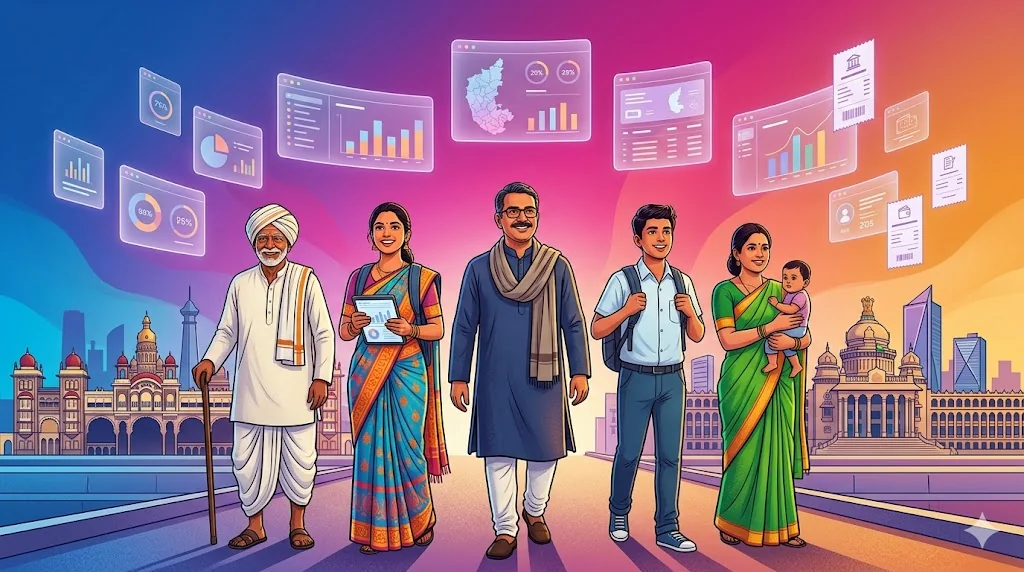
The People's Model is the answer to this page.
If the diagnosis is an execution gap, the cure is an execution system. Five non-negotiable commitments form the spine of Volume I — every chapter that follows is the detail of one of them.
A single state operating spine
One identity, one service registry, one citizen case file, one Open Ledger, one grievance system — all anchored through the Karnataka State Service Log (KSSL).
Outcome budgeting & open contracting
Every rupee tagged to a measurable outcome. Every contract on the Open Contracting Data Standard. Every payment tied to milestone evidence anyone can verify.
State capacity over contractor dependency
A Project Delivery Cadre and a Karnataka State Works Corps that bring engineering, maintenance, and essential manufacturing back in-house where markets have failed.
A 24/7 governance engine
Mission Control workflows. Service charters for the top 100 services. Automatic escalation when deadlines slip. Citizen ratings that trigger audits, not anniversaries.
Digital rights as default
The Citizen Data Trust gives residents ownership of their data. The AI-Use Register lists every state AI. The Grievance Justice Authority gives appeals statutory teeth.
The People's Model begins from a refusal to accept this loop as inevitable.
It is not. · ಗದ್ದಲ ಕಡಿಮೆ · ಫಲಿತಾಂಶ ಹೆಚ್ಚು · ನಂಬಬಹುದಾದ ರಾಜ್ಯ